The $4.28 Billion Daily Milestone: How the AI Super-Cycle is Fueling a Structural “K-Shaped” Export Surge

[Key Insights at a Glance]
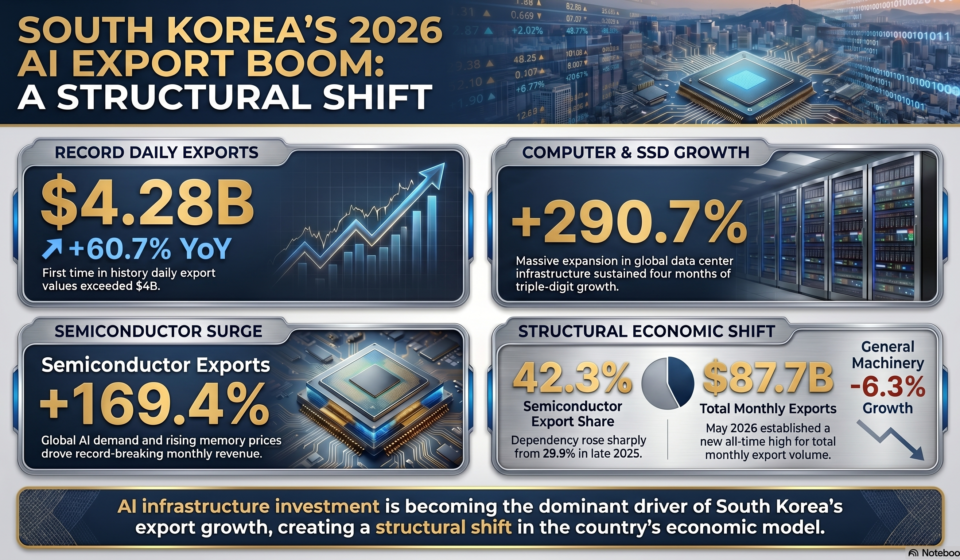
- 60.7% Daily Export Growth: South Korea’s average daily exports surged 60.7% year-over-year in May 2026, reaching a record $4.28 billion per day for the first time.
- 42.3% Semiconductor Weight: Semiconductors now account for 42.3% of total exports, underscoring the country’s increasing exposure to the global AI infrastructure buildout.
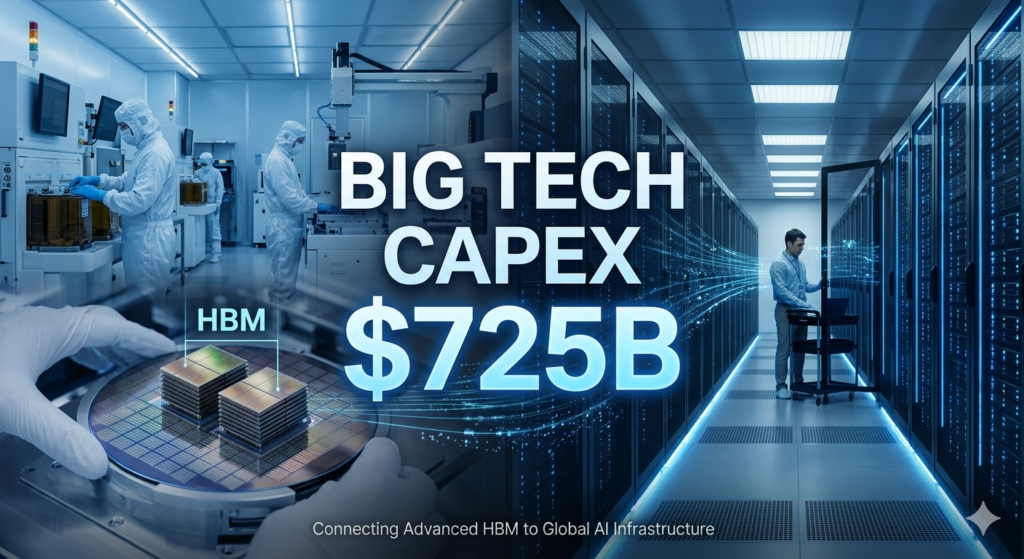
- $725 Billion AI Investment Wave: Global hyperscalers are expected to spend roughly $725 billion in capital expenditures in 2026, with about 75% directed toward AI infrastructure, providing a strong demand backdrop for the semiconductor industry.
[Deep Dive Analysis]
South Korea’s export engine is being powered by one dominant force: AI.
Exports reached $87.7 billion in May 2026, while the trade surplus hit a record $26.9 billion. The surge was led by semiconductors and AI-related hardware, with semiconductor exports rising nearly 180% year-over-year and computer/SSD exports jumping around 300%.
The story, however, is becoming increasingly concentrated. Semiconductors now account for 42.3% of total exports, up sharply from 29.9% just months ago. This reflects the global rush to build AI infrastructure, supported by an estimated $725 billion in hyperscaler CAPEX this year.
Not all industries are sharing the benefits. While AI-linked sectors are enjoying a powerful growth cycle, autos, machinery, and steel continue to face weaker demand and trade pressures. The result is a clear K-shaped economy, where technology leaders are pulling further ahead.
Looking forward, rising imports of semiconductor manufacturing equipment suggest the boom is still in its expansion phase. As capacity grows, the benefits could gradually spread to Korea’s broader materials, components, and equipment industries.
[💡 Editor Hoi’s Insight]
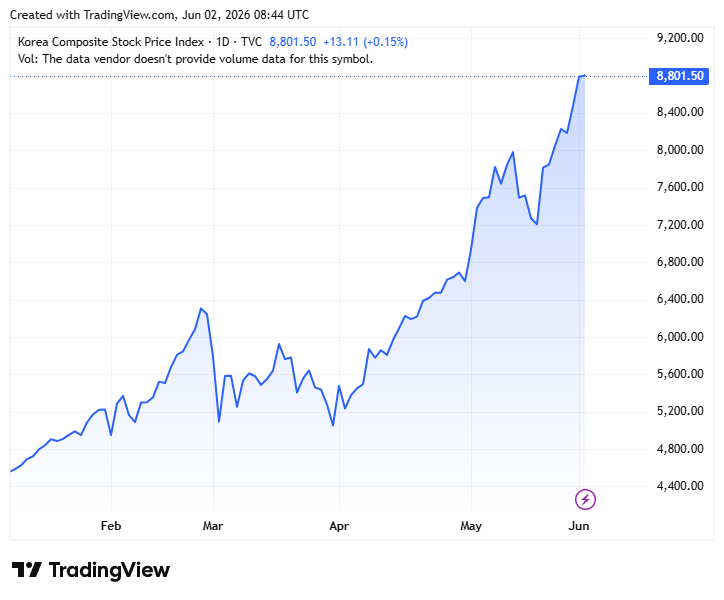
This looks less like a temporary export spike and more like a structural shift.
The AI infrastructure cycle has become the primary driver of Korea’s export growth, creating significant opportunities across the semiconductor value chain. While concentration risk remains, continued investment by global tech giants supports a constructive long-term outlook for chipmakers, equipment suppliers, and materials companies.