The 100% Disclosure Mandate: How Korea’s New Treasury Stock Rules Spark a Structural Re-rating

[Key Insights at a Glance]
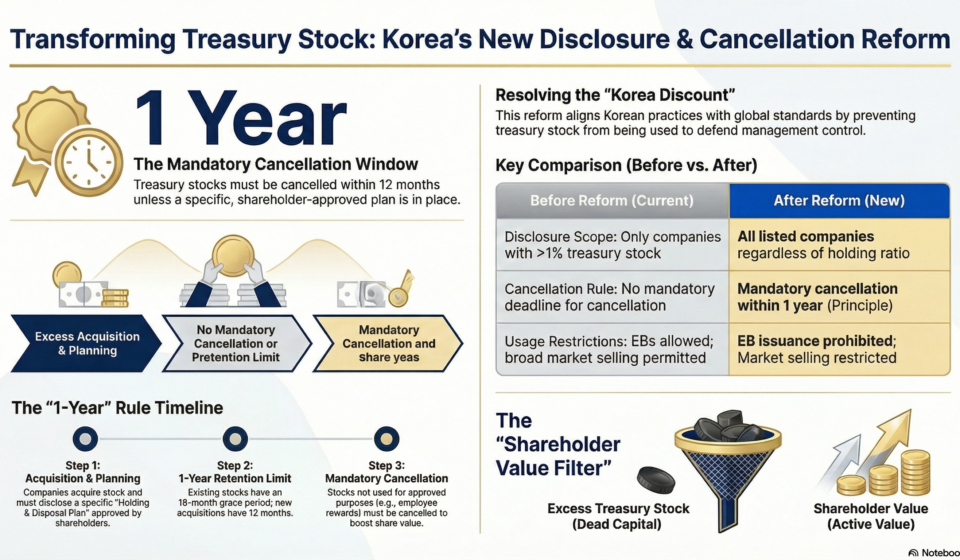
- 100% Disclosure Coverage: Mandatory bi-annual disclosure of treasury stock plans now applies to all listed companies, regardless of holding percentage.
- Strict 1-Year Cancellation: New treasury shares must be canceled within 1 year of acquisition; existing holdings must be cleared within 1.5 years.
- Closing the Loopholes: The issuance of Exchangeable Bonds (EBs) backed by treasury shares and open-market sales to the public are now strictly prohibited.
[Deep Dive Analysis]
The Financial Services Commission (FSC) has initiated a legislative notice (March 31 – May 11, 2026) that marks a definitive end to the “Korea Discount”. By enforcing the mandatory cancellation of treasury shares within a 1-year window, the FSC is dismantling the “hoarding” culture that has historically suppressed shareholder value. Furthermore, expanding rigorous disclosure to 100% of listed firms ensures that investors can track exactly how and when buybacks are executed.
This is a structural shift in capital management. Previously, companies could use treasury shares as a defense mechanism or as underlying assets for EBs. The revised Capital Markets Act closes these loopholes, banning EB issuance against treasury stock and prohibiting disposal during trust contract periods. While specific block deals remain permitted, the ban on general open-market sales ensures treasury stocks finally serve their true purpose: long-term corporate value enhancement.
[💡 Editor Hoi’s Strategic Insight]
The overhaul of Korea’s treasury stock framework creates a classic asymmetry for global investors. This isn’t just a compliance update—it’s a structural normalization.
- EPS/ROE Expansion: The elimination of “zombie” treasury shares will lead to a predictable increase in EPS (Earnings Per Share) and ROE (Return on Equity) across the market.
- Investment Signal: The strategic play here is to identify fundamentally sound companies with large existing treasury holdings. The forced cancellation cycle (1.5-year grace period) will trigger a widespread re-rating catalyst.
This regulatory shift is a definitive long-term holding signal for Korean equities, as companies are now legally mandated to engage in genuine shareholder return programs.
Data Source: Press Release by the Financial Services Commission (FSC), March 31, 2026
The 42-day public comment period runs until May 11, 2026.